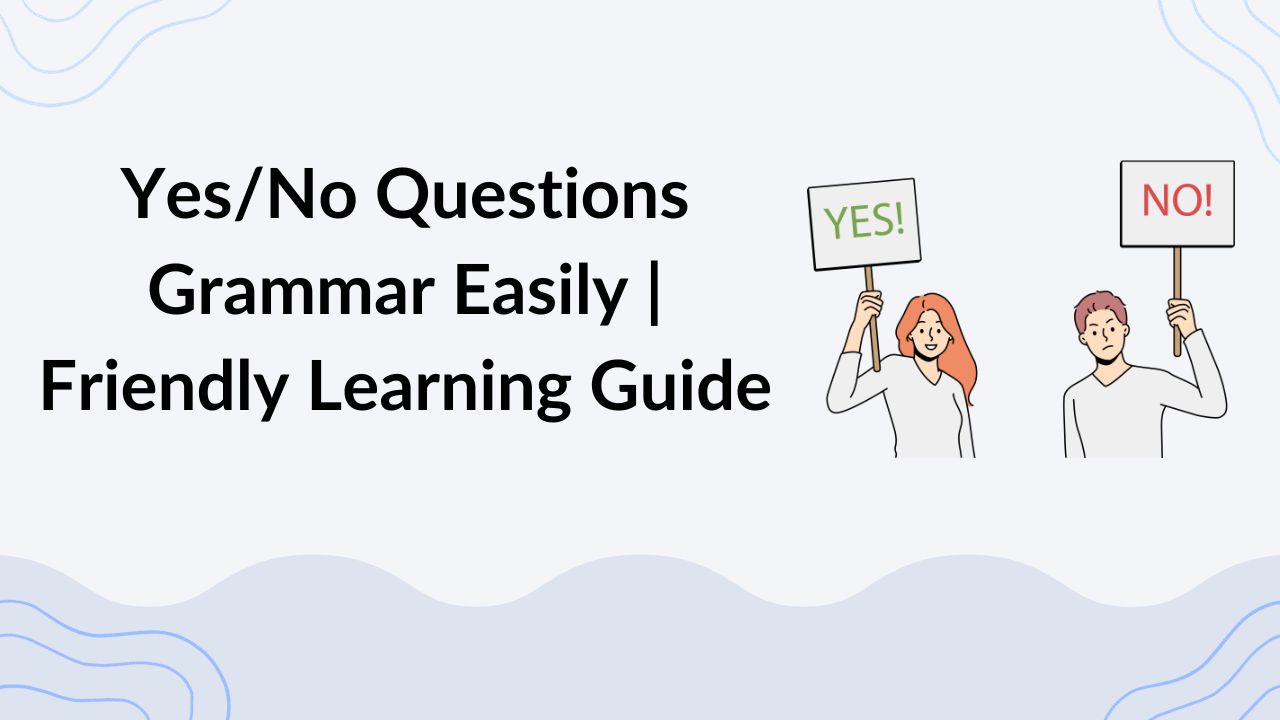
Yes/No Questions Grammar Easily | Friendly Learning Guide
Are you struggling with the grammar of yes/no questions grammar in English? Do you find it challenging to form grammatically correct questions? If yes, then you’ve come to the right place. In this comprehensive guide, we will simplify the rules and provide examples to enhance your understanding of yes/no questions. Whether you’re a beginner or looking to improve your language skills, this guide has got you covered.
Key Takeaways
- Formation of yes/no questions is a fundamental aspect of English grammar.
- Rules such as subject-verb inversion and verb-subject agreement should be followed to construct correct yes/no questions.
- Proper word order is crucial in yes/no questions to avoid confusion.
- Practice exercises are essential to reinforce your understanding and improve your skills.
- Mastering the grammar of yes/no questions will enhance your overall English language skills.
Understanding Yes/No Questions Grammar
Before we dive into the rules of forming yes/no questions, let’s first understand what they are. Yes/no questions are a type of interrogative sentence that can be answered with a simple “yes” or “no.” They often begin with an auxiliary verb, such as “do,” “does,” “did,” “am,” “is,” “are,” “was,” “were,” “have,” “has,” or “had.”
The structure of a yes/no question is straightforward. It typically follows this formula:
Auxiliary verb + subject + main verb + object?
For example:
Do you like pizza?
In this example, the auxiliary verb is “do,” the subject is “you,” the main verb is “like,” and the object is “pizza.” The question can be answered with a simple “yes” or “no.”
There are two types of yes/no questions: closed and open. Closed questions have a limited number of possible answers, usually “yes” or “no.” Open questions, on the other hand, allow for a more extended response beyond “yes” or “no.”
Here are some examples of closed and open yes/no questions:
- Closed: Do you like coffee?
- Open: What do you like to drink in the morning?
- Closed: Has she finished her project?
- Open: What is she working on right now?
Yes/No Question Syntax
Yes/no questions follow a specific syntax, with the auxiliary verb typically coming before the subject. However, in certain situations, the word order may differ slightly.
Here are some examples:
- Do you have a pen?
- Have you seen the new movie?
- Is she coming to the party?
- Can I borrow your car?
- Should we leave now?
- Would you like some water?
As you can see from the examples above, the auxiliary verb typically comes before the subject. However, in questions that use the “be” verb, the subject comes before the auxiliary verb:
- Are you feeling okay?
- Is he coming to the concert?
- Was she at the meeting?
- Were they happy with the results?
By understanding the structure and syntax of yes/no questions, you can begin to form accurate and grammatically correct questions in English.
Basic Rules for Forming Yes/No Questions
Yes/no questions are a fundamental part of English grammar, and constructing them correctly is essential for effective communication. Here, we will explore the rules for forming yes/no questions, including subject-verb inversion and verb-subject agreement, to ensure your questions are grammatically accurate.
Subject-Verb Inversion in Yes/No Questions
In a yes/no question, the subject and verb must be inverted, meaning that the verb comes before the subject. For example:
Statement: You are a writer.
Question: Are you a writer?
Notice how the verb “are” is placed before the subject “you” in the question. This inversion provides a clear indication that a question is being asked.
Subject-verb inversion is also necessary when the question is formed using a helping verb. In this case, the helping verb comes before the main verb, and the subject follows the main verb. For example:
Statement: She is playing tennis.
Question: Is she playing tennis?
Here, the helping verb “is” comes before the main verb “playing,” followed by the subject “she.”
Verb-Subject Agreement
Another essential rule for forming yes/no questions is verb-subject agreement. This means that the verb must agree with the subject in number (singular or plural). For example:
Statement: They speak Spanish.
Question: Do they speak Spanish?
In this example, the verb “speak” agrees with the plural subject “they.”
If the subject is singular, the verb should be in the singular form. For example:
Statement: He plays guitar.
Question: Does he play guitar?
The singular verb “plays” agrees with the singular subject “he.”
By following these rules for forming yes/no questions, you can construct clear and accurate questions that convey your intended meaning. We’ll explore word order and provide examples of well-formed questions in the following sections.
Word Order in Yes/No Questions
The word order in yes/no questions is crucial for clear communication. The proper placement of words helps ensure coherence and avoids confusion when forming questions in English.
The most common word order for yes/no questions is:
Auxiliary + Subject + Main Verb
The auxiliary verb is positioned at the beginning of the sentence, followed by the subject, and then the main verb. This structure differs from declarative sentences, where the subject comes before the verb.
Here is an example to illustrate the proper word order:
Statement: They are going to the beach.
Question: Are they going to the beach?
| Word Type | Example |
|---|---|
| Auxiliary Verb | Is, are, am, was, were, have, has, had, do, does, did, can, could, will, would, shall, should, may, might, must |
| Subject | I, you, he, she, it, we, they, who, what, where, when, why, how |
| Main Verb | Base form of verb (infinitive) or past participle |
Note: If the sentence does not include an auxiliary verb, the main verb is used as the auxiliary. For example:
Statement: John runs five miles every day.
Question: Does John run five miles every day?
In the example above, the main verb “run” is used as an auxiliary verb to form the question. The word order follows the same pattern as before: auxiliary verb + subject + main verb.
It’s important to note that in some cases, the main verb can come before the subject. This occurs in imperative sentences where the hidden subject is “you”. For example:
Statement: Go to bed early.
Question: Do you go to bed early?
In this example, the main verb “go” comes before the subject “you”.
Yes/No Question Verb Placement
The placement of the verb in a yes/no question varies depending on the verb tense and whether or not an auxiliary verb is used. In general, the auxiliary verb comes before the subject, and the main verb follows the subject.
Here are some examples of verb placement:
- Present Simple: Do you like pizza?
- Present Continuous: Is she watching TV?
- Present Perfect: Have they finished their homework?
- Simple Past: Did you have breakfast this morning?
- Past Continuous: Was he playing soccer when you called?
- Simple Future: Will you be attending the meeting tomorrow?
- Future Perfect: Will they have arrived by noon?
When forming questions with modal verbs (can, could, should, would, etc.), the modal verb is placed at the beginning of the sentence and followed by the subject and base form of the main verb. For example:
Statement: He can speak Spanish.
Question: Can he speak Spanish?
By understanding the word order and verb placement rules for yes/no questions, you can improve your communication and grammar skills in English.
Examples of Yes/No Questions
Now that we have covered the rules and structure of yes/no questions, let’s look at some examples:
Is she coming to the party tonight?
Can you help me with this assignment?
Did you watch the movie last night?
Will they be joining us for lunch later?
As you can see, forming yes/no questions requires the use of auxiliary verbs (e.g., is, can, did, will) at the beginning of the sentence. These verbs are then followed by the subject and the main verb.
Let’s take a closer look at some additional examples:
| Statement | Yes/No Question |
|---|---|
| I like ice cream. | Do I like ice cream? |
| The train arrives at 9am. | Does the train arrive at 9am? |
| We should leave now. | Should we leave now? |
Note that the use of question words (e.g., what, where, why) is not necessary in yes/no questions. However, they can be added for clarification or to gather more information.
With practice, you will become more comfortable with forming and using yes/no questions in your everyday conversations.
Common Mistakes to Avoid in Yes/No Questions
Even with a solid grasp of the rules for forming yes/no questions, there are still common mistakes that can trip you up. Here are some errors to avoid:
- Forgetting to invert the subject and verb: In yes/no questions, the subject and verb must be inverted. For example, the statement “You are coming to the party” becomes “Are you coming to the party?” when turned into a question.
- Using the wrong auxiliary verb: Depending on the tense and subject, different auxiliary verbs are required for yes/no questions. For example, for present tense questions with “you” as the subject, “do” is used as the auxiliary verb (“Do you like pizza?”), but for third-person singular subjects, “does” is used (“Does she like pizza?”). Make sure to use the correct auxiliary verb to avoid confusion.
- Forming questions without an auxiliary verb: In some cases, yes/no questions require an auxiliary verb to be formed correctly. For example, the sentence “He ate pizza” cannot be turned into a yes/no question without an auxiliary verb, such as “did” (“Did he eat pizza?”).
- Using the wrong word order: The word order in yes/no questions is subject-verb inversion. If this order is not followed, the question will not be grammatically correct. For example, the question “You like pizza, do you?” is incorrect because the subject and verb have not been inverted.
- Adding unnecessary words or phrases: Yes/no questions should be concise and to the point. Adding unnecessary words or phrases can make the question confusing or convoluted. For example, the question “Could you possibly tell me where the restroom is, please?” could be simplified to “Where is the restroom?”
Avoiding these common mistakes will help you construct accurate and natural-sounding yes/no questions.
Exercises to Practice Yes/No Questions
Now that you have a solid understanding of the rules for forming yes/no questions, it’s essential to practice applying them. The exercises below will help you refine your skills and build your confidence in constructing grammatically correct questions.
Exercise 1: Basic Formation
In this exercise, you will practice forming basic yes/no questions. Look at the statement provided and rewrite it as a question. For example:
Statement: She is a doctor.
Question: Is she a doctor?
Complete the following exercises:
- They live in New York.
- He likes pizza.
- She went to the store.
- We are going to the movies.
- You have a dog.
Exercise 2: Subject-Verb Inversion
This exercise focuses on questions that require subject-verb inversion. Rewrite the statement as a question, placing the auxiliary verb before the subject. For example:
Statement: They have seen that movie before.
Question: Have they seen that movie before?
Complete the following exercises:
- He is studying for the test.
- We should leave soon.
- They have finished their project.
- You can speak Spanish.
- She will be here tomorrow.
Exercise 3: Short Answers
In this exercise, you will practice giving short answers to yes/no questions. For example:
Question: Are you hungry?
Short Answer: Yes, I am.
Complete the following exercises:
- Do you like coffee?
- Is it cold outside?
- Did they call you yesterday?
- Can he swim?
- Will they be at the party?
By regularly practicing these exercises, you will solidify your understanding of yes/no question formation and confidently apply the rules in your speaking and writing. Remember to review the rules as needed and continue practicing to improve your skills.
Enhancing Your Grammar Skills with Yes/No Questions
Mastering the grammar of yes/no questions is essential for enhancing your overall English language skills. As you continue to improve your understanding of the rules and patterns involved in forming these questions, consider the following guidelines to further enhance your grammar:
Practice, Practice, Practice
The more you practice forming yes/no questions, the more natural and accurate your sentences will become. Use the exercises provided in section 7 to reinforce the rules and patterns learned throughout this guide. Additionally, incorporate the formation of yes/no questions into your daily communication to enhance your fluency.
Pay Attention to Word Order
As discussed in section 4, the word order in a yes/no question is critical for clear communication. Pay close attention to the positioning of words in your questions, ensuring that they maintain coherence and avoid confusion.
Read and Listen to English Regularly
Reading and listening to English regularly is an excellent way to enhance your grammar skills. Exposure to different contexts and sentence structures will help you familiarize yourself with the rules and patterns involved in forming yes/no questions and other grammatical structures.
Seek Feedback
Request feedback from native English speakers or language instructors to identify areas of improvement in your grammar. Implement their suggestions to enhance your overall communication skills.
By following these guidelines and continuing to practice, you will master the grammar of yes/no questions and improve your overall English language skills.
Keywords: improving yes/no question structure, guidelines for yes/no questions.
FAQ
What are yes/no questions grammar?
Yes/no questions are interrogative sentences that can be answered with either a “yes” or a “no”. They are used to seek information or confirmation.
How do I structure a yes/no question?
In English, yes/no questions typically follow a subject-verb inversion pattern, meaning the verb comes before the subject. For example, “Are you coming?”
What types of yes/no questions can I form?
You can form yes/no questions using various auxiliary verbs, such as “do,” “does,” “did,” “is,” “are,” “am,” “was,” “were,” “have,” “has,” “had,” “can,” “could,” “should,” “will,” “would,” “may,” “might,” and “must.”
What is the correct word order in a yes/no question?
The general word order for a yes/no question is: auxiliary verb + subject + main verb. For example, “Do you like ice cream?”
Can I place the main verb before the subject in a yes/no question?
Yes, it is possible to place the main verb before the subject in certain situations, such as when using certain auxiliary verbs like “have,” “be,” or “do.” For example, “Have you seen the movie?”
What are some examples of well-formed yes/no questions?
Here are a few examples of well-formed yes/no questions: “Did you finish your homework?” “Are they coming to the party?” “Have you ever been to France?”
What are some common mistakes to avoid when forming yes/no questions?
One common mistake is forgetting to invert the subject and verb in questions. It’s important to ensure that the verb comes before the subject. Additionally, be careful with auxiliary verb usage and word order.
How can I practice forming yes/no questions?
To practice forming yes/no questions, you can create your own questions based on different scenarios or use exercises specifically designed for this purpose. These exercises will help solidify your understanding of the grammar rules.
How will mastering the grammar of yes/no questions enhance my overall English skills?
Mastering the grammar of yes/no questions will improve your overall English language skills by enhancing your ability to communicate effectively and accurately. It will also make your English speech and writing sound more natural and fluent.